This is the hub for how solar hardware works, which options fit which places, and what to look for. Use the discussion at the bottom to ask about anything not covered.
Solar cell and panel types
| Type | Typical panel efficiency | Notes |
|---|---|---|
| Monocrystalline silicon (TOPCon, PERC) | 21 to 24 percent | The standard choice today. TOPCon has largely replaced PERC. |
| Heterojunction (HJT) | 22 to 24 percent | Excellent in heat thanks to a low temperature coefficient. |
| Back contact (IBC) | 22 to 25 percent | All wiring on the back for higher efficiency and a clean look. |
| Polycrystalline silicon | 15 to 18 percent | Older and cheaper; rarely sold new now. |
| Thin film (cadmium telluride) | 18 to 20 percent | Common in large U.S. solar farms; handles heat well. |
| Perovskite silicon tandem | Lab cells above 30 percent | Early commercial stage. See New Solar Technology. |
Bifacial panels collect light on both sides and can add 5 to 20 percent more energy on ground mounts over light colored ground or snow.
Where and how panels are mounted
- Pitched roofs: rails bolted to rafters with flashing to keep water out.
- Flat roofs: weighted (ballasted) frames that tilt panels without roof penetrations.
- Ground mounts: easier to clean and orient; good for farms and large lots.
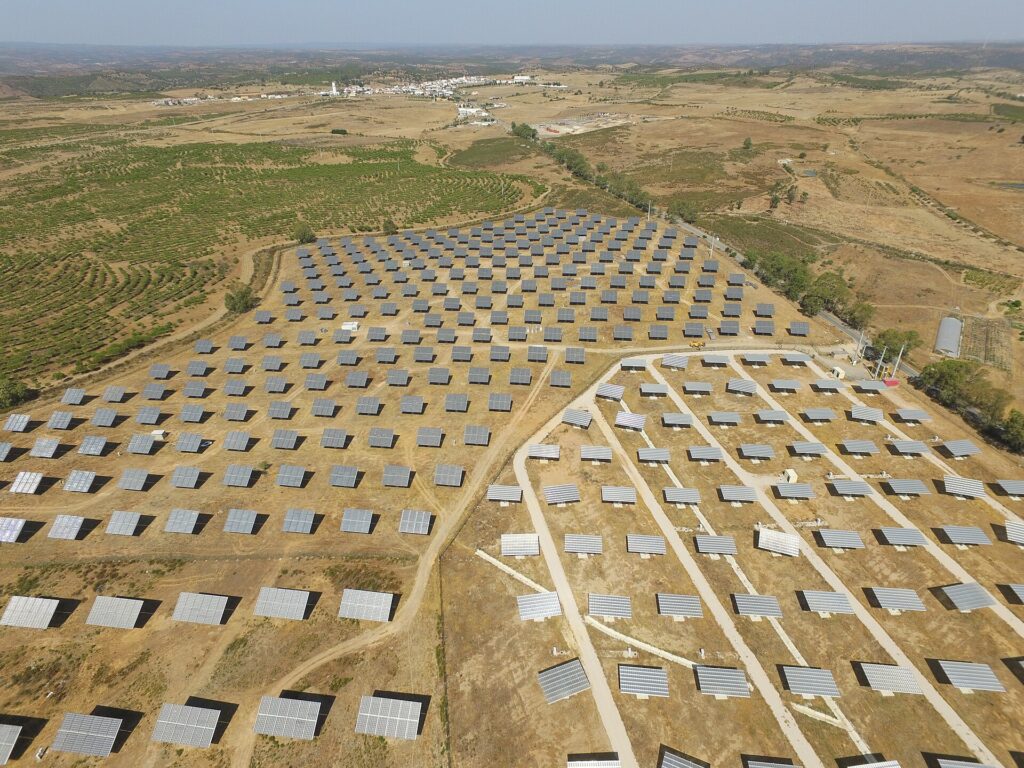
- Single axis trackers: turn panels east to west through the day, adding roughly 15 to 25 percent energy. Standard for large solar farms.
- Carports and canopies: shade parking and walkways while producing power.
- Floating solar: panels on reservoirs and ponds that cut evaporation.
- Building integrated PV: solar roof tiles, facades and windows that replace building materials.
- Balcony or plug in solar: one or two small panels that plug into an outlet, allowed in some places but not others. Check local rules.
Solar water pumping
Solar pumps are one of the most valuable uses of solar across rural Latin America, the Caribbean and the North American plains. The panels drive a DC or AC pump directly, and the water tank does the storing, so most systems need no battery at all.
- Uses: livestock watering, drip irrigation, household water and community wells.
- Sizing depends on the daily water volume and the total lift from water level to tank.
- Pair with drip irrigation to get the most crop per liter.
- Farmers often replace diesel pumps and see fast payback thanks to fuel savings.
Solar heat: water heating and concentrated solar power
Solar water heaters use rooftop collectors to heat water directly. They are common in Brazil, Mexico and the Caribbean and are often cheaper than electric water heating. Concentrated solar power (CSP) uses mirrors to focus sunlight and make steam for turbines. Chile’s Cerro Dominador in the Atacama pairs a CSP tower with molten salt storage that lets it deliver power at night.
Performance, heat and climate
- Heat: check the temperature coefficient. Around minus 0.3 percent per degree Celsius or better is good for hot climates.
- Hurricanes: use racking rated for local wind speeds, more attachment points and through bolted clamps.
- Snow and cold: steeper tilt sheds snow; account for higher voltage in cold weather when sizing strings.
- High altitude: the Andes and Mexican plateau get strong sun; UV rated components matter.
- Coastal salt air: choose panels tested for salt mist corrosion.
Safety and codes
Solar systems carry high DC voltages. They must be installed to local electrical codes (such as the National Electrical Code in the United States, the Canadian Electrical Code, or NOM standards in Mexico), with proper grounding, labeling and rapid shutdown where required. Only licensed electricians should work on wiring.
End of life and recycling
Panels are mostly glass, aluminum and copper. Recycling companies now operate in the United States, Canada, Brazil and Chile, and several states and countries are developing take back rules. Reusing working panels from upgraded systems is also growing, especially for off grid uses.
Discuss this topic
Have a question, a correction, or real world experience to share? Start the conversation below. Replies are reviewed before they appear.