The sun sets every evening and hides behind clouds for days. Storage fills those gaps. This page compares every major way to store energy, from a battery in your garage to water pumped uphill, heat stored in sand, and hydrogen made from sunlight.
Why storage matters
- Backup power when the grid goes down, vital in hurricane zones and places with frequent outages.
- Using your own solar at night instead of exporting it cheaply and buying back expensive evening power.
- Cutting demand charges for businesses by trimming short power peaks.
- Keeping the grid stable as more solar and wind come online.
- Powering places with no grid, from ranches to island villages.
Every type of storage compared
| Type | Typical duration | Round trip efficiency | Best uses | Maturity |
|---|---|---|---|---|
| Lithium iron phosphate (LFP) batteries | 1 to 8 hours | 85 to 95 percent | Homes, businesses, grid | Mature, dominant |
| Nickel manganese cobalt (NMC) batteries | 1 to 4 hours | 85 to 95 percent | Electric vehicles, some storage | Mature |
| Lead acid batteries | Hours | 70 to 85 percent | Low cost off grid, backup | Mature, declining |
| Sodium ion batteries | 1 to 8 hours | About 85 to 92 percent | Grid and home storage, cold climates | Early commercial |
| Flow batteries (vanadium, zinc, iron) | 4 to 12 hours | 60 to 80 percent | Grid and industrial long duration | Commercial, niche |
| Iron air batteries | About 100 hours | Around 40 to 50 percent | Multi day grid storage | First deployments |
| Pumped hydro | 6 to 24+ hours | 70 to 85 percent | Large grids | Mature, largest in the world |
| Compressed air (CAES) | Hours to days | 40 to 70 percent | Grid scale in caverns | Commercial, few sites |
| Liquid air | Hours to days | 50 to 60 percent | Grid scale | Demonstration |
| Gravity (blocks, weights in shafts) | Hours | 70 to 85 percent | Grid scale, old mines | Demonstration |
| Flywheels | Seconds to minutes | 85 to 95 percent | Grid frequency control | Commercial, niche |
| Supercapacitors | Seconds | 90+ percent | Power quality, bursts | Commercial, niche |
| Thermal (hot water, molten salt, sand, bricks, ice) | Hours to seasons | Varies widely | Heating, cooling, industry, CSP plants | Mature to emerging |
| Green hydrogen | Days to seasons | About 30 to 40 percent as electricity | Seasonal storage, fuel, fertilizer | Early commercial |
| Electric vehicles (vehicle to home or grid) | Hours | 80 to 90 percent | Home backup, virtual power plants | Early commercial |
Efficiency figures are typical ranges and depend on design and use.
Batteries
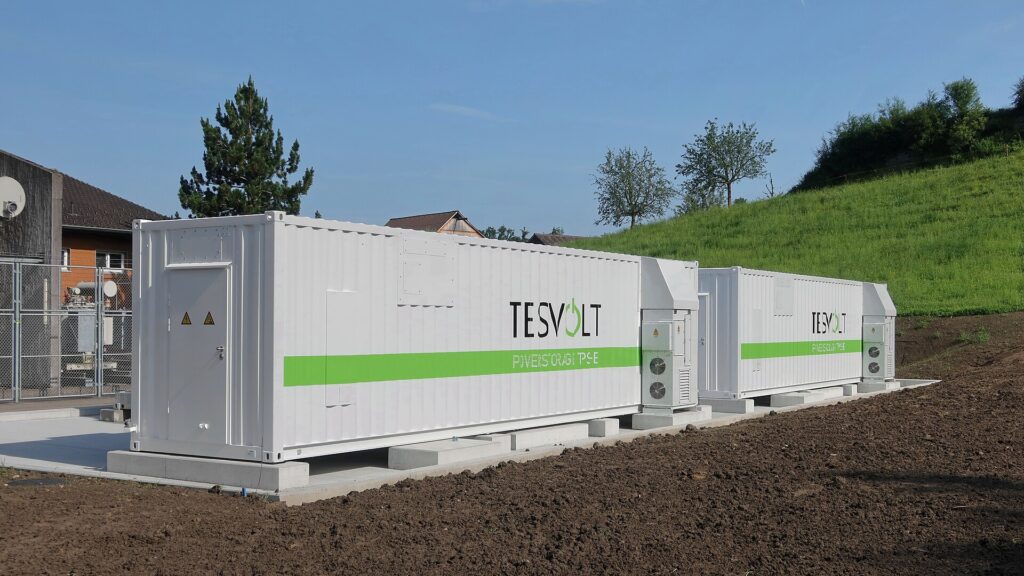
Batteries are the workhorse of solar storage today, for homes and for the grid. Prices for lithium iron phosphate cells have fallen dramatically, and huge battery plants in California, Texas and Chile now shift solar into the evening. Full details: Batteries.
Hydrogen
Hydrogen made by splitting water with solar power can be stored for months, used as fuel, or turned into ammonia fertilizer. It is less efficient than batteries for storing electricity but can do jobs batteries cannot. Full details, including making hydrogen on a farm: Green Hydrogen.
Mechanical storage
Pumped hydro pumps water to an upper reservoir when power is cheap and runs it back through turbines when needed. It holds most of the world’s stored electricity. Canada, the United States and Brazil have major hydro systems that already act like giant batteries for solar and wind. Compressed air stores energy in salt caverns or tanks; new projects in Canada and California use heat recovery for better efficiency. Gravity storage lifts heavy blocks or weights in shafts, including in retired mines. Flywheels spin rotors at high speed for split second grid balancing.
Thermal storage
Often the cheapest way to store solar is as heat or cold. A heat pump water heater running on midday solar stores energy in hot water for the evening. Ice storage makes ice at night or midday for air conditioning later. Concentrated solar plants store heat in molten salt; Chile’s Cerro Dominador runs through the night this way. Newer systems heat sand or bricks to high temperatures for industrial heat.
Electric vehicles as storage
An electric vehicle battery often holds several times more energy than a home battery. With a bidirectional charger and a compatible vehicle, it can power a home in an outage or sell power to the grid. Utilities are running pilot programs, and more vehicles now support this.
Safety and standards
Choose listed equipment (for example UL 9540 systems in North America) and follow fire codes such as NFPA 855, which set limits on size, spacing and location for batteries in homes and buildings. In Latin America, check national standards and utility requirements.
Discuss this topic
Have a question, a correction, or real world experience to share? Start the conversation below. Replies are reviewed before they appear.